时间:2025-08-26 点击量:
“室内空气环境质量控制”天津市重点实验室建造环境(BERL)课题组张稼昕博士在中科院一区Top期刊《Renewable and Sustainable Energy Reviews》(影响因子IF:16.3)上发表了关于后疫情时代可以兼顾病原污染物快速去除和节能的通风新范式。

后疫情时代需要平衡污染物快速去除和能源效率的通风系统:文献综述
Ventilation systems balancing rapid pollutant removal and energy efficiency in the post-pandemic era: a literature review
Jiaxin Zhang (张稼昕), Junjie Liu (刘俊杰), Zhipeng Deng (邓志鹏), Sumei Liu (刘素梅 通讯作者)
· 现有的室内通风系统优先考虑污染物的稀释效果而不是直接去除污染物。
· 目前的评价指标主要反映通风系统的稀释性能造成过高的换气次数。
· 送风与排风结合形成靶向流动可以兼顾节能和快速去除污染物。
· TARGETING靶向指标可用于量化通风系统对污染物的快速去除能力。
· 确定后疫情时代通风系统新范式所面临的挑战及未来设计方向。
2019冠状病毒病大流行和呼吸道病毒的持续威胁凸显了在室内环境中建立高效通风系统的重要性。病毒气溶胶极大地促进了疾病的空气传播,对防疫工作构成了重大挑战。通风系统在降低病毒气溶胶浓度方面发挥着至关重要的作用,从而减轻了封闭空间中的传播风险。然而,目前的大流行指南提倡100%使用新鲜空气和高通风率,这不可避免地导致能源消耗增加。本文献综述探讨了各种通风策略和评价指标,旨在识别能够快速去除病毒气溶胶同时节能的通风系统。特别强调将送风与排风结合起来的重要性。
通风技术发展时间轴线:民用建筑通风系统发展规律由全空间充分混合稀释向特定区域送风排除污染转变。意在改善局部热舒适,实现污染物快速稀释,如图1(a)所示。
工业通风系统由于高大空间限制,优先考虑以最小的能量输入直接去除或封闭污染物,如图1(b)所示。SARS和COVID-19等呼吸传染病的爆发,人们意识到微小的病原微生物气溶胶传播就可以造成巨大的健康暴露危险,凸显了传统民用建筑通风系统的一个关键局限性:那些主要为稀释而设计的通风系统必须依靠提高通风率(换气次数)来改善空气质量,这往往会导致严重的能源损失。
得益于工业通风系统在高效排污和节能方面的优势,后疫情时代已有研究将工业通风原理在民用建筑环境中加以改进应用。

图1 (a)民用通风发展时间线,(b)工业通风发展时间线
空气传播机制:空气传播是指病毒或细菌等传染性病原体通过空气进行长距离传播,通常超出了飞沫传播的范围。世界卫生组织(WHO)和美国疾病控制与预防中心(CDC)已经正式确认,COVID-19可以通过气溶胶(尺寸小于5 μm的空气传播)传播。呼吸、说话、咳嗽和打喷嚏等呼吸活动产生的飞沫范围为0.1 μm到2000 μm。如果个人被感染,这些飞沫可能含有传染性病原体。较大的液滴(大于100 μm)往往在几秒钟内迅速沉降到表面上,而较小的液滴(小于5 μm)被称为气溶胶,可以在空气中悬浮很长时间,促进空气传播,如图2所示。适当的通风有助于减少空气传播的风险,并确保更安全的室内环境。因此,有效的通风系统设计对于控制空气传播的病毒至关重要。
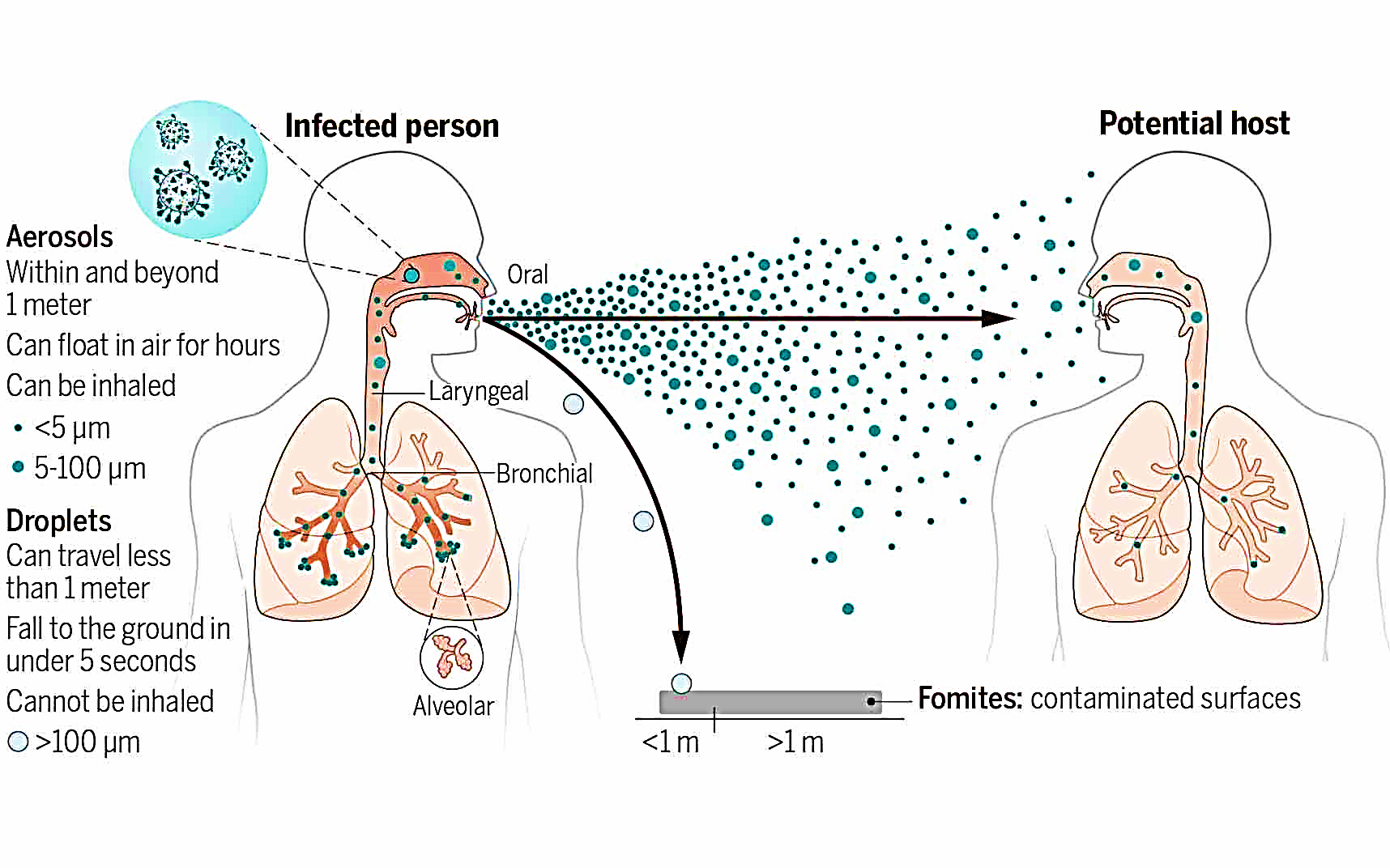
图2 呼吸道病毒经空气传播的特征
传统通风策略和防疫效果对比分析:图3给出了使用标准化评分方法(0~100分)比较六种通风策略(混合通风MV、置换通风DV、个性送风PV、分层通风SV以及贴附通风WAV)的雷达图,其中得分越高表示相对于其他系统的性能越好。目前的研究主要强调污染物的快速稀释,如PV,SV,而不是从源头上及时去除污染物,这是有效降低疾病传播风险的关键因素。
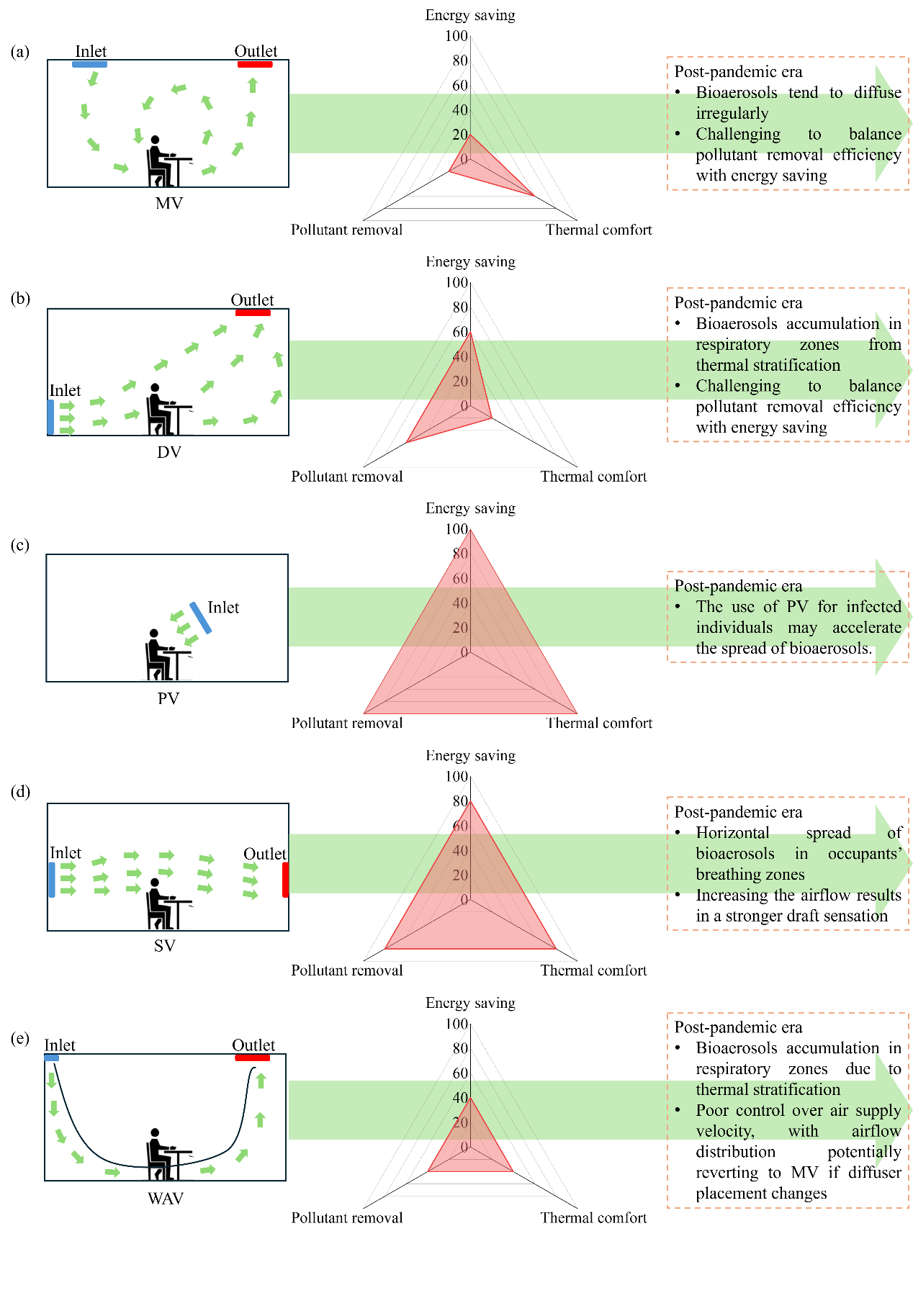
图3 不同通风系统应对疫情时的优势及缺陷
评价通风策略通风性能指标:表1总结了不同指标反映的特征维度,并提出了在不同公共卫生背景下应用这些指标的建议。现有的通风设计依靠稀释来减少疾病传播,并将新鲜空气输送到占用区。空气龄和送风可及度(ASA)描述稀释的快速性,而平均浓度(AC)、净逃逸速度(NEV)和净化流量(PFR)则描述稀释的有效性。在疫情期间,通风设计的重点应从高效稀释转移为快速去除污染物,特别是在高风险区域。建议采用排风口污染物平均浓度(AC)以及排污效率(VE)等指标描述通风系统对污染物去除的有效性。使用靶向排污性能(TARGETING)描述通风系统对污染物去除的快速性。
表1 不同指标反映的特征信息摘要以及大流行前后推荐使用的指标。
Indicator | Dilution Capability | Energy Efficiency | Spatial Distribution | Recommend Use (Pre-Pandemic) | Recommend Use (Pandemic) |
AC (within space) | √ | × | × | √ (Focus on dilution) | × |
AC (at outlet) | √ | × | × | × | √ (Focus on removal) |
Air Age | √ | √ | √ | √ | × |
ACS/ ASA | √ | √ | × | √ | × |
VE (removal-based) | √ | √ | √ | √ | √ |
PFR | √ | × | √ | × | √ |
NEV | √ | × | √ | × | √ |
SFIF | × | × | √ | × | √ |
Vortex Identification | × | × | √ | × | √ |
TARGETING (new) | √ | √ | √ | × | √ (Strongly recommend for high-risk) |
兼顾高效控制快速去除和节能降耗通风新范式:分区通风系统(Partitioned ventilation)快速隔离污染物,有效控制和防止污染物的不规则扩散。推拉式(Push-pull ventilation)和负压增强(Negative pressure-enhanced ventilation)通风系统营造定向流动(定向排污路径),促进污染物的快速清除。这些系统特别适用于高风险环境,包括疫情期间病原微生物气溶胶污染严重的公共建筑和医院。与传统的通风系统相比,这些新方法强调排风的关键作用。送风主要是为了配合排风,以确保对污染物的高效控制和捕集,而不是稀释。因此,当室内污染物浓度升高如疫情期间也不需要提供额外的风量,具备优异的节能潜力。表2总结了这些系统在实际应用中的有效性。
表2 送风与排风组合对室内空气污染物去除的影响。
Ventilation system | Authors and References | Application | Type of application | Evaluation method | Indicators | Effectiveness in removing contaminants |
| Wang, et al. | Painting factories | Industry | Particles | Escape ratio | Increasing push-pull ventilation airflow velocity generally decreases mist particle escape ratio. |
Zhou, et al. | Industrial buildings | Industry | Tracer gas | Performance coefficient | Airflow control improved by 30.5%; diffusion height of supplied airflow reduced by up to 57%. | |
Watson, et al. | Electronic factory | Industry | Tracer gas | Capture efficiency | Capture efficiency increased between 55.2% and 136.8% with active push airflow. | |
Zhou, et al. | Kitchen | Civilian | Tracer gas | AC | Push-pull system reduced contaminants in the breathing zone by 23.7%. | |
Zhang, et al. | Negative pressure isolation room | Civilian | Particles | TARGETING | Push-pull systems improved rapid contaminant removal performance by 88.1%~96.4% compared to traditional methods. | |
Zhou, et al. | Kitchen | Civilian | Tracer gas | Capture efficiency | Push-pull systems significantly enhanced exhaust hood efficiency. | |
| Shih, et al. | Clean room | Industry | Tracer gas | Sealing efficiency | Achieved maximum sealing efficiency of 0.87. |
Ma, et al. | Industrial environment | Industry | Tracer gas | Protective effect | At an air supply velocity of 0.5 m/s, PE values for BA, BAF, and BAFS helmets approached 0.844, 0.985, and 1, respectively. | |
Zhao, et al. | Large building spaces | Civilian | Tracer gas | Infiltration efficiency | Installation height significantly affects sealing efficiency; maximum efficiency was 0.72. | |
Tan, et al. | Hospital | Civilian | Particles | AC | Air isolation measures resulted in zero particle settlement on patients and beds. | |
Chen, et al. | Hospital | Civilian | Tracer gas | Removal ratio | Air curtains in consulting rooms reduced exhaled pollutant concentrations by 55%~80% compared to rooms without air isolation. | |
Luo, et al. | Complex building | Civilian | Tracer gas | AC | Effectively suppressed pollutant dispersion. | |
| Chen, et al. | Factory | Industry | Tracer gas | AC | Enhanced exhaust ventilation reduced breathing zone pollutant concentrations to 89% compared to existing systems. |
Pech, et al. | Laboratory | Industry/ Civilian | Tracer gas | Capture efficiency | Increasing supplied-to-exhausted air momentum flux ratio extended the high-efficiency capture area (above 80%) horizontally but reduced it vertically. | |
Yang, et al. | Indoor | Civilian | Particles | Visual presentation | Achieved a pollutant removal rate of up to 100%. | |
Spotar, et al. | Kitchen | Civilian | Tracer gas | Swirling value | Optimal parameters resulted in a capture zone extending up to four inlet diameters from the extractor entrance, as indicated by the velocity vector field. |
通风策略与其他措施配合回顾:高效空气(HEPA)过滤器、等离子、光催化灭菌和紫外杀菌(UVGI)等系统可以有效地对室内和风管中的空气进行消毒,而不会产生有害的副产物,从而减少所需的通风量并节省能源。双极等离子电离模块可以有效地对空气进行灭菌,但可能产生有害的副产物,需要仔细控制离子浓度。佩戴N95口罩的防护效果相当于将通风量提高20倍。提高口罩的使用同样可以减少通风率,有助于节约能源。在室内保持社交距离并设置物理屏障同样可以减少通风需求,CDC建议社交距离为2 m,佩戴口罩后社交距离可缩短为0.5 m。上述措施与通风策略结合可进一步降低通风量。
智慧通风控制策略回顾:这些通风策略包括基于社会距离和居住者密度检测、间歇性占用调度、感染风险-能耗模型,以及利用信息和通信技术(ICT)、物联网(IoT)和人工智能(AI)技术监测室内空气质量和室内环境质量(IEQ)等新型通风策略。这些方法的预测准确率超过90%。表3总结了这些策略的适用性、有效性和潜在的节能效果。
表3 对论文提出的通风控制策略进行分类,分析其控制效果和节能潜力
Strategy | Building Types | Control effect | Energy saving potential | References |
Occupant-density-detection | University building | Reduced infection probability to 2%. | Achieved 11.7% energy savings. | [299] |
Occupant-density-detection | University building | Zonal demand-controlled ventilation significantly reduced infection risk to 2.8%. | 34% improvement in energy efficiency compared to constant ventilation systems. | [300] |
Occupant-density-detection | Classroom | Improved thermal sensation by 0.57~1.09, thermal comfort by 43~73%, thermal acceptability by 18~48%; maintained CO₂ <700 ppm. | Cooling system energy consumption reduced by 2.3~8.1%. | [334] |
Occupant-density-detection | Office | Maintained infection risk under 2%. | Reduced coil load by 52.44%. | [335] |
Occupant-behavior-detection | Gym | Reduced infection risk by 4.3~6.3%. | Achieved 13% energy savings. | [336] |
Intermittent occupancy | Classroom, Conference room, Office | Asking occupants to vacate rooms during breaks reduced airborne infection risk by 35%. | / | [60] |
Intermittent occupancy | Classroom | Achieved required IAQ. | Demand-controlled optimization achieved up to 88% energy savings. | [327] |
Infection risk-energy consumption model | Residence, workplace, school, sports building, public transport, subway station, restaurant, supermarket, shopping center, wholesale market | Reduced R0 to 1, curbing pandemic spread. | Reduced energy use by 13.7% on weekdays and 45.1% on weekends. | [328] |
Infection risk-energy consumption model | Airport | / | Reduced energy consumption by 71~85% with dynamic passenger flow control. | [337] |
Infection risk-energy consumption model | University building | Significantly lowered transmission rate. | Achieved a tenfold reduction in energy costs. | [338] |
ICT for monitoring IAQ and IEQ | University building | Linked COVID-19 infection risk directly to CO₂ concentration for ventilation adjustments. | Reduced energy consumption by 15~30%. | [339] |
ICT and IoT for monitoring IAQ and IEQ | University building | Linked COVID-19 infection risk directly to CO₂ concentration for ventilation adjustments. | / | [329] |
IoT for monitoring IAQ and IEQ | University building | / | Integrated building automation and IoT achieved 20% energy savings. | [330] |
AI for monitoring IAQ and IEQ | Laboratory | Reduced pollutant removal time by 63.65%. | Reduced energy use by 63.65%. | [331] |
AI for monitoring IAQ and IEQ | Office | / | Achieved energy savings up to 50%. | [340] |
本文系统综述了五种常见机械通风策略(MV、DV、SV、WAV、PV),定量评价了它们在污染物去除和能效方面的效果。分析强调,目前大多数通风系统优先考虑输送新鲜洁净空气来稀释污染物,但往往忽视了排风的重要性,导致室内空气质量不佳和不必要的能源消耗,特别是在大流行等高致病风险条件下。借鉴工业通风实践,强调了在住宅和民用公共建筑中,联合供气和排气系统实现污染物快速去除、实现节能和热舒适的新范式。TARGETING指标的应用使污染物去除速度的评价成为可能。在后疫情时代,高占用率、封闭或通风不良的空间(例如教室、公共交通工具、办公室)在工程设计时应借鉴工业通风污染物去除理念,以提高抵御病原微生物空气传播感染风险的能力。同时,利用物联网环境感知技术和智能多目标控制策略是平衡室内空气质量、热舒适性和能源效率的关键因素,据报道节能高达57%,感染风险降低高达75%。未来的暖通空调设计应该从以空间为中心过渡到以居住者为中心的范式,与健康、低碳和适应性的建筑运行目标保持一致。本文为未来通风系统设计的跨学科研究和实践创新提供了全面的分析和明确的方向建议,支撑更安全、更智能和更可持续的室内环境营造。
致谢:该研究获得“十四五”国家重点研发计划“大气专项”项目(NO. 2022YFC3702800)资助。
本文引用格式: Zhang, J., Liu, J., Deng, Z. et al. Ventilation systems balancing rapid pollutant removal and energy efficiency in the post-pandemic era: a literature review. Renewable and Sustainable Energy Reviews, 225 (2025) 116175. https://doi.org/10.1016/j.rser.2025.116175.
如需阅读原文,请查看附件。